

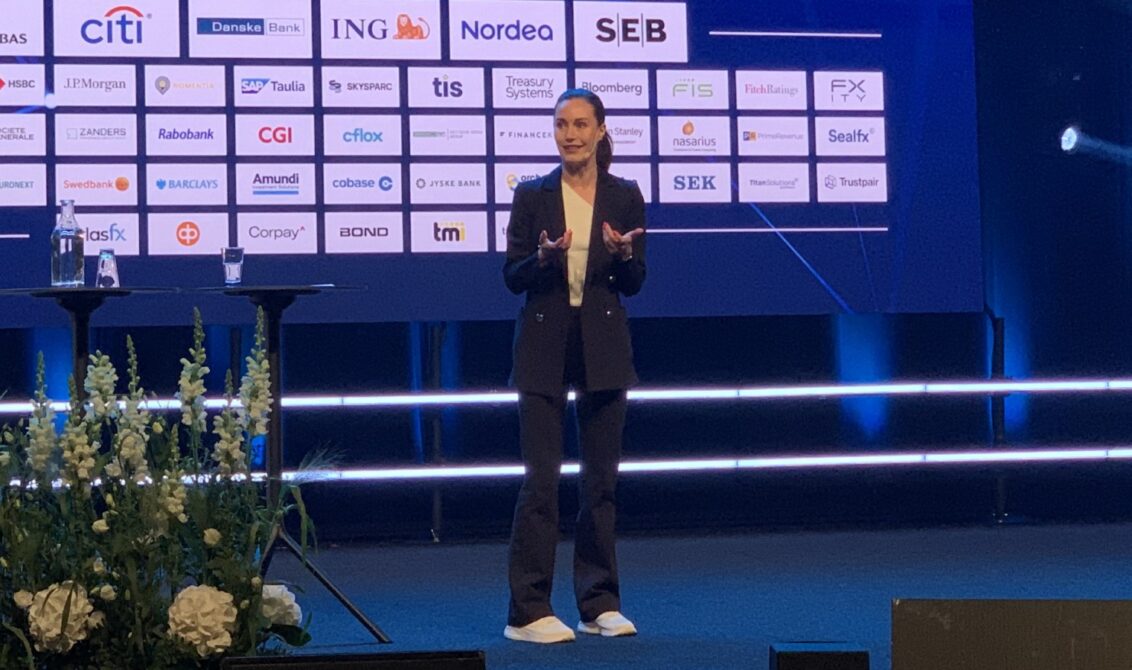
Marin’s speech began with a story from her childhood. In the small town she once called home, there was a forest by her school. The forest was a popular recreational spot for the town’s children, who loved to play among the trees. The forest was on private land – so when the landowner announced one day that the forest was going to be demolished, dismay swept through the community.
This pushed Marin into her very first political endeavour. Together with a group of friends, she took a walk down a street while waving mini Finnish flags. The children – all just eight or nine years old – were unsure what to do, so settled on singing the national anthem as a protest.
Although on a much smaller scale, Marin likened the demolition of that beloved forest and community space to the current dismantling of international order as we know it.
“Europe is at an interesting crossroad where old alliances, old partnerships – the transatlantic cooperation that we have been relying for such a long time – have changed and is changing,” she said.
Three points of weakness
She identified three critical vulnerabilities in Europe under the new world order: defence, energy,and technology.
On defence, she said, “We thought wrong when we thought that after the collapse of the Soviet Union, a big ideological battle was resolved.” As recent events have proven, that was never true. Therefore, “when we built close economic ties and reliances with countries such as Russia, we also put ourselves in an extremely vulnerable place.”
Given the current political climate, NATO members have agreed to increase their defence budgets to 5% of their GDP by 2035. Marin lauded the strategy, but reminded the audience that “much more important than the target itself, or the amount of money we spend, is where we actually spend it.”
Modern warfare is a battle of new technologies; she believes that investment should focus on defence capabilities that can be updated and modified to respond and match technological changes on the enemy front.
Besides defence, another key factor in the safety and wellbeing of European citizens is energy. “Europe’s electricity prices are now more than twice as high as those in the US and China. This creates structural disadvantage to Europe the fields of AI and in our industries in general. If we pay twice as high prices as our main competitors, there is a big bottleneck,” Marin pointed out.
“We need to invest in our energy capabilities and ideally, in production that is cleaner than before – not only because it serves our climate target, but also because clean energy is not as vulnerable as natural gas or oil or other fossil fuels.”
She circled back to the topic of technology – this time, outside of defence. Here, current numbers do not look good. “We lack behind global competitors in seven out of eight critical technologies, including AI, robotics, and quantum. For example, the US has produced more than 240 technological firms valued above US$10 billion compared to just 14 in Europe,” Marin cited. “The differences and the scale – it’s completely different when we compare Europe and the US.”
“Our societies are already very digitalised, and will be fully digitalised in the future… If we don’t invest in our own technological capabilities, not only in defence, but also otherwise, we won’t be competitive in the future; we won’t keep our citizens safe.”
Action plan needed
When discussing Europe’s vulnerabilities, the bigger question is perhaps why solutions have yet to be found. “The Ukraine war started four years ago… China and the US have been investing in new technologies for ages,” Marin pointed out. In every conference she has attended since, these events have been described as the “wake-up call for Europe” – but the region keeps hitting the snooze button.
“We are still too comfortable; we don’t want to wake up,” Marin said. “We wanted to see the world in the way we wish it to be, not with realistic eyes and ugly truths.”
She believes that the region requires stronger leadership. “The kind of leadership that I would want to see in Europe right now would be the kind that understands the core values we want to protect and push forward in the world… Democracy, rule of law, individual rights of people… The principles that the European Union was based on. Our leaders should have these core values not only in their written speeches, but in their backbone.”
A future of regrowth
The current challenges will not mean the end of Europe, just as losing the forest was not the end of the story from Marin’s childhood. Following the demolition of the forest, Marin’s school orgniased a tree planting project for students to replant trees that were removed. Now, 30 years later, there is a forest once again.
“The lesson learnt was not one of devastation or hopelessness,” said Marin. It was hope.
“We are, in the European Union, 27 countries. When we look at the 27 individual countries, every single country, even Germany, is small compared to the US and China. But when you combine these 27, or all the European countries, then we are actually big. We’re the biggest economy in the world, we are a great power, we are not as incompetent as we think. We have many things in our favour – we have talented people, we have a strong economy, we have a lot of potential. We can do amazing innovations, and we can also scale them up if we play our parts wisely.”
• News from Treasury 360° Nordic 2026, at Gothia Towers in Gothenburg on 23 April, is gathered here.
• And why not spread the posts in our LinkedIn flow? Sign up to follow if you don’t already – and share this post!
• Find here the main conference website, with the agenda.
• Download the event magazine here .
• Many sessions appear in full as videos in the days or weeks after the event.