

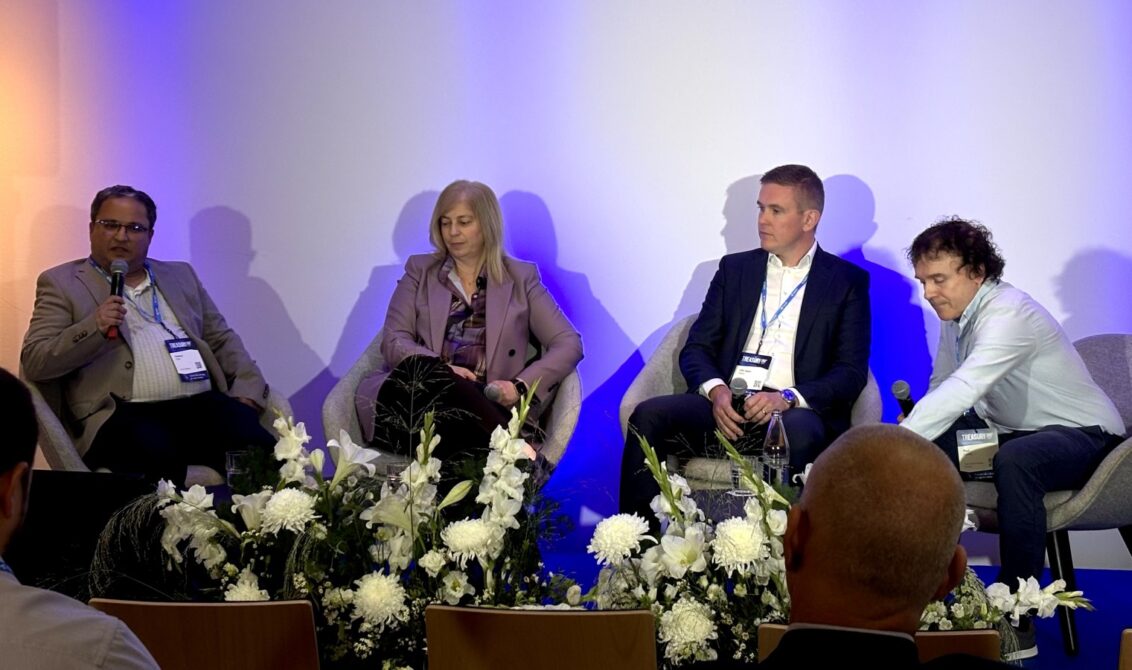
That was the starting point for the panel Trimming the hedge – lessons in FX volatility management at Treasury 360° Europe 2026.
John James Dunne, Founder & Principal at Elevate Treasury Advisory and former group treasurer, put the first challenge to the audience: how many treasurers really understand the foreign currency exposures sitting across all their business units?
Very few hands went up.
“Before you establish a hedging programme, you need to understand and be comfortable with the underlying exposure,” Dunne said. His advice was straightforward: get closer to the business, understand what drives its revenues and costs, and build relationships with the teams generating the exposures.
Natural hedging
For Marianna Polykrati, Group Treasurer at Cooke HELLAS, that business partnership becomes particularly important when traditional hedging is not available.
She described situations where management did not want to hedge or where bank facilities were unavailable. In those cases, the team turned to natural hedging – matching receivables and payables across currencies and adjusting loans to offset the remaining exposure.
“Natural hedging is nice. You can do it on a monthly basis and try and see your receivables, see your payables, and play around with your debt,” she said. “But it’s not easy. It’s time-consuming, and you need to be right on top of the business.”
At Avery Dennison, Sandeep Nene described a more sophisticated approach, using value-at-risk and correlations between currencies. But even there, the starting point remains the same.
“You can’t hedge everything,” Nene said. “So you have to choose what you want to hedge.”
He also questioned the logic behind arbitrary percentage hedging. Hedging 70% of an exposure, for example, is meaningless without understanding the risk represented by the remaining 30%.
AI and forecasting
That understanding also depends heavily on forecasting. Polykrati stressed the importance of challenging sales and procurement forecasts rather than simply accepting the numbers provided.
“The quality of the forecasting tool depends upon the quality of the data inside,” she said.
And AI could eventually help. Dunne sees potential for AI to identify hidden FX exposures, improve forecasting and strengthen feedback loops. But there is a line he is not yet ready to cross.
“It definitely can help us be better informed, make better decisions,” he said. “I’m not sure I would quite trust AI to log into a trading platform and execute a deal for me.”
For the panel, the technology may evolve, but the fundamentals of FX risk management remain familiar: understand the business, understand the exposure and make sure the hedge serves a clearly defined purpose.
Speakers:
John James Dunne, Founder & Principal | Former Group Treasurer | Former Irish ACT President, Elevate Treasury Advisory
Paul Golden, Freelance journalist/event moderator, Paul Golden Writing Services
Sandeep Nene, Director of Treasury, Avery Dennison
Marianna Polykrati, Group Treasurer, Cooke HELLAS
• News from Treasury 360° Europe 2026, are gathered here.
• And why not spread the posts in our LinkedIn flow? Sign up to follow if you haven’t already – and share this post!
• Find here the main conference website, with the agenda.
• Download the event magazine here .
• View sessions in full after the event on our video page.