

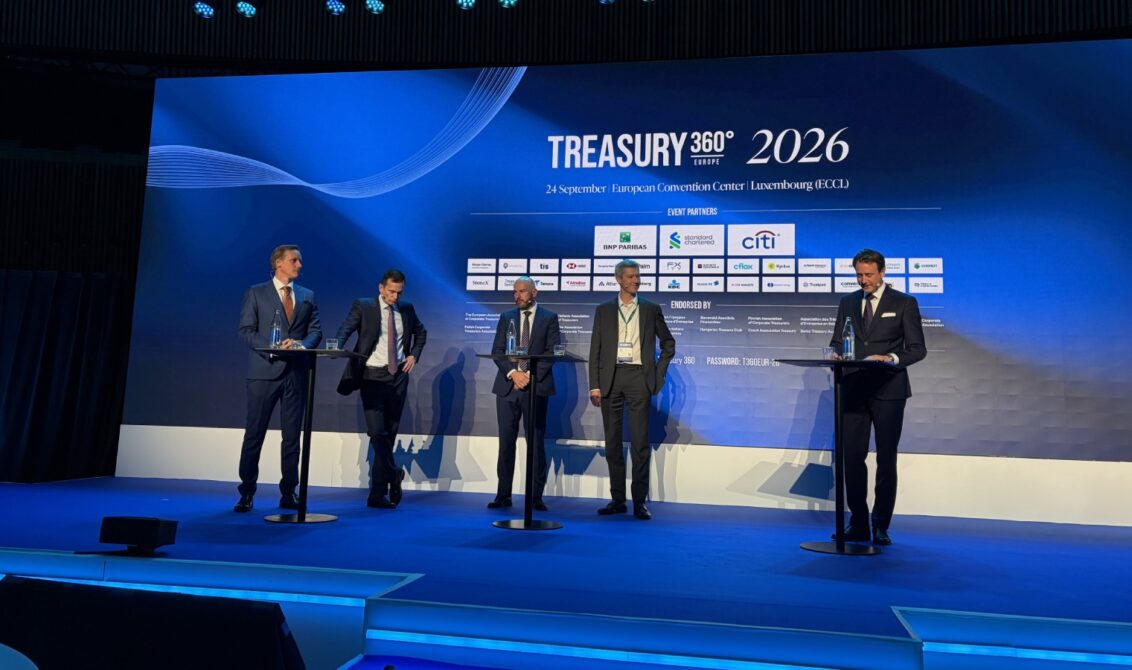
Simon Hesse Hoffmann, chair of the conference, launched the panel with a provocative question: “Why are banks so keen to control corporates?
Alexey Sokolov, head of Origination Europe at HSBC jumped in to defend the banks. “We have the duty of care to all the customers – that happen to be corporates as well – on the other side, that have put their money with us,” he points out.
To him, funding negotiations are an act of balance that has to take into account the ambition of the corporates that are looking for funding, and the limitations of the bank as a lender. “We have the responsibliity of getting money back,” he emphasises.
Agree to disagree
Hoffmann argued that signed agreements are not effective instruments. “You can add all the governance you want, but it’s not protected,” he says. “If the borrower can pay, nobody opens the agreement. When the borrower cannot pay, it’s too late, so it’s a false sense of protection.”
Sokolov disagreed. His description of funding contracts sounded remarkably similar to prenuptial agreements. “When times are great, that’s usually when we sign the agreements – we’re obviously in love with each other at a point in time. But the agreement is for the time when we hate each other.
“That’s why we need to be deliberate and comprehensive about what can potentially go wrong. We cannot really think of all the scenarios, but we can reasonably come up with a few of them.”
Honesty can backfire
As with any relationship then, communication and trust are key in funding negotiations, but such honesty could also be a double edged sword. Kasper Christensen, senior director of Global Treasury at Pandora illustrated this by comparing it to internal operations. “We see the same situation internally in the company sometimes, where, if somebody misses reporting on something, the first thing we do is to look at the controls that can be put in place. Eventually, you have a lot of people managing the controls, which doesn’t create any value for anybody.”
“I think it’s the same problem that sometimes arises with loan agreements, where, in a business that’s running fine, we have to think about what to report… And that can create a potential default, which is a very uncomfortable risk to have. That’s a default of a technical nature, which is frankly unnecessary, and nobody benefits from.”
A way out
If the going gets too tough, Simon Gates, head of Corporate Banking UK at BNP Paribas suggested that the answer could be to look outside of banks altogether. “Diversifying is good. If you’re entirely reliant on your banks, that’s not a great situation to be in. Other forms of lending are much less documented and have a lot more flexibility.” He named investment grade bonds as an alternative, citing them as “a good starting point”.
Christensen agrees. “As a corporate, you can give yourself many options by having an alternative. The strongest thing you can do in a negotiation is having an alternative; it’s not necessarily about being the toughest guy in the room. If everybody knows that you have other options, you’re in a better position. It doesn’t mean you can get everything you want, but you can get some of the things you want.”
Finally, a successful negotiation might simply rely on both parties being reasonable. Christensen points out, “You need to be close to your bank group and understand how they see you as credit. Obviously, you can’t ask for double-A terms if you’re a triple-B credit. It doesn’t work that way.”
Speakers:
Kasper Christensen, Senior Director, Global Treasury, Pandora
Simon Gates, Head of Corporate Banking UK, BNP Paribas
Simon Hesse Hoffmann, Chair of the conference
Rasmus Olesen, Director, Head of Financing and Investments (Legal), European Energy A/S
Alexey Sokolov, Head of Origination Europe, HSBC Bank plc
• News from Treasury 360° Europe 2026, are gathered here.
• And why not spread the posts in our LinkedIn flow? Sign up to follow if you haven’t already – and share this post!
• Find here the main conference website, with the agenda.
• Download the event magazine here .
• View sessions in full after the event on our video page.